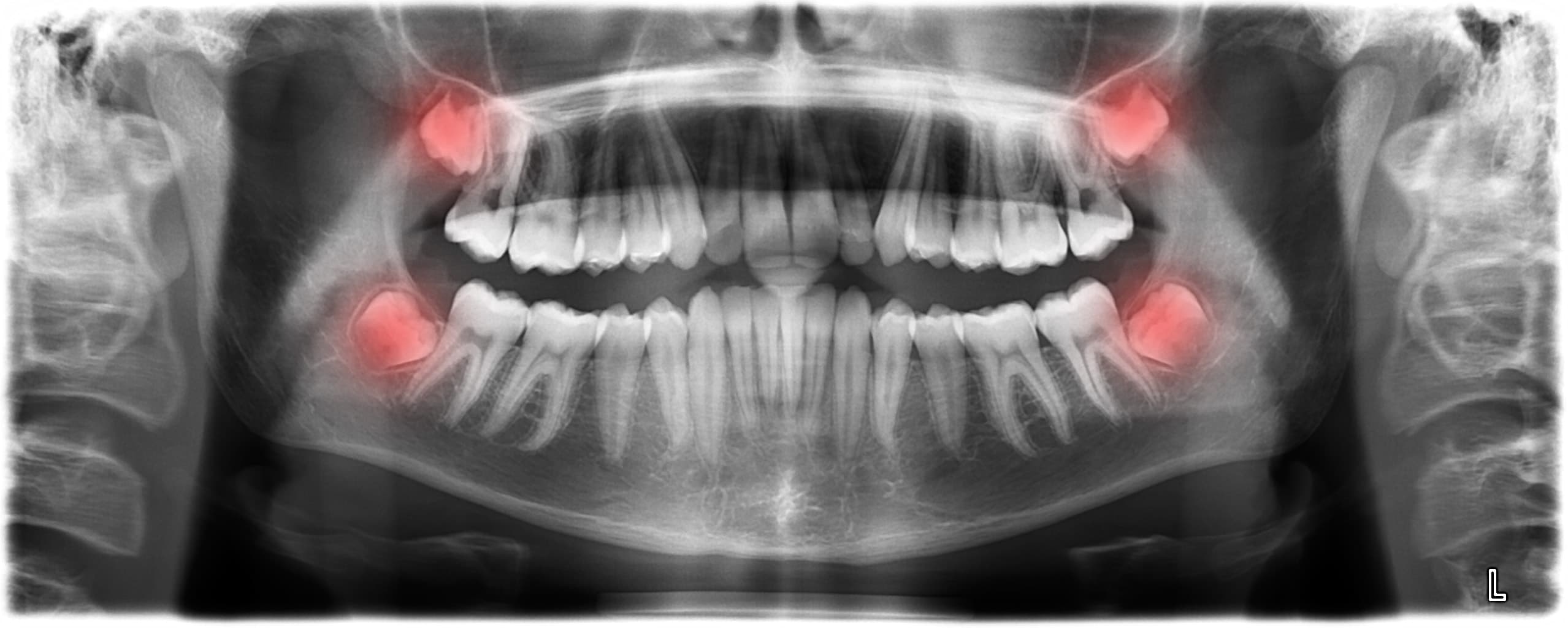
The wisdom tooth is the name given to the third molar, the last tooth at the back of the dental arch. It appears in the mouth between the ages of 16 and 25, but it is already present in the jaw, not yet erupted, well before that. Most people have four, but some may have fewer — or even more.
Why do they cause problems?
A lack of space in the jaws can lead to eruption problems, preventing the wisdom teeth from reaching their natural, functional position. They then remain completely impacted, or partially trapped under the gum and bone. The tooth may also erupt in the wrong direction. Various complications can then arise:
- displacement of the other teeth
- painful inflammation
- infections, abscesses, cellulitis
- cysts
- decay or loosening of the adjacent teeth
Do they always need to be removed?
It is not necessary to remove wisdom teeth routinely, but it is possible to predict whether they will cause problems. A radiograph of the jaws (panoramic radiograph or orthopantomogram) allows the practitioner — dentist, orthodontist or maxillofacial surgeon — to assess the likelihood of complications. We recommend this examination from the age of 14, and in all cases where orthodontic treatment is carried out.
The procedure
Wisdom teeth are generally removed by the maxillofacial surgeon, especially when they are impacted. The procedure can be carried out at the practice, under local anaesthesia, or in hospital under general anaesthesia. The choice of method depends on the number of teeth, their position and complexity, and the patient's wishes — also taking into account their state of health and their ability to cooperate. All these elements are discussed at the first consultation.
Recovery
Recovery may involve pain and localised swelling, which vary greatly from one person to another. On average, allow four days off (between 0 and 15 days), and 2 to 3 weeks of discomfort when brushing your teeth and eating.
Complications are rare. Bleeding may occur in the hours following the procedure (see the post-operative advice). Late infections are seen in 1% of cases, after 1 to 3 months, due to the difficulty of maintaining good local hygiene. For the lower teeth, altered sensation in the lower lip or tongue may occur; this is due to nerve irritation and disappears spontaneously after a few weeks. Permanent sensory disturbance is exceptional (less than 1 in 2,000) and only occurs in certain cases that can be suspected and discussed in advance.